
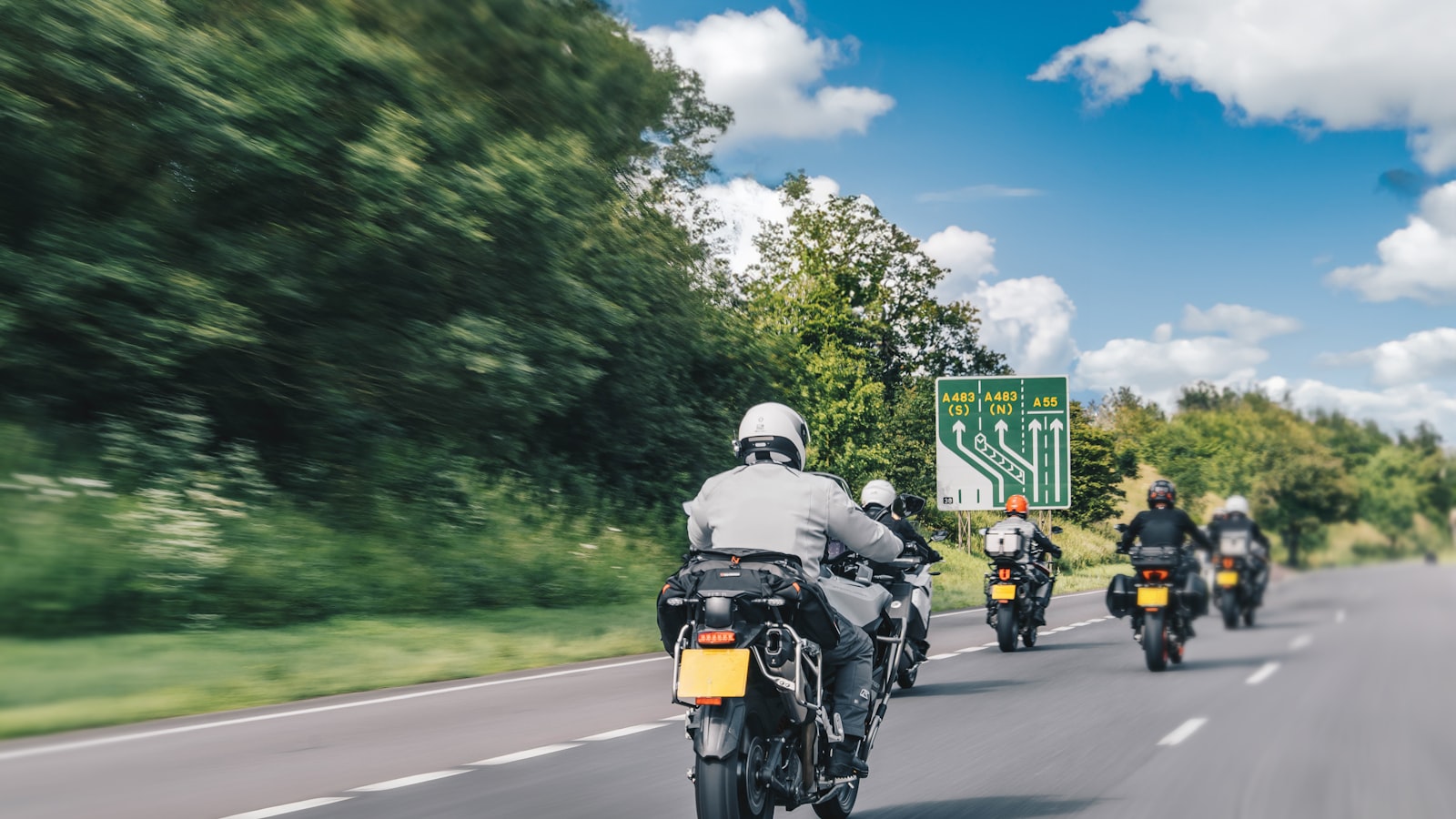
Why group intercom changes a ride
Riding in a group without comms means hand signals, guesswork and pulling over to regroup. A group intercom keeps everyone on one channel — call out hazards, agree on the next turn, or just talk the miles away. The question is not whether to run comms, but which connection type fits your group, and how much that choice is worth paying for.
Chain and mesh are two different things — here is the honest difference
Chain networking — also sold as “group” or “one-touch” networking — links riders in sequence: unit 1 finds unit 2, unit 2 finds unit 3, unit 3 finds unit 4. When the last unit is linked, everyone is on the channel. It is quick to set up, and it is what most intercoms in this price class actually do, whatever the box says.
The trade-off is real and worth knowing before you buy. If a rider in the middle drops out or falls too far behind, the riders behind them lose the link until the group re-connects. On a tight ride that is a non-event — the link comes back as they close up. On a strung-out ride through traffic, it means re-linking more often than you would like.
Mesh networking works differently. Every unit holds a link with every other unit in range, so the group heals itself when one rider drops back or leaves. Nobody has to do anything. That resilience is genuinely better — and you pay for it. At the time of writing, a single mesh headset from Cardo or Sena sits around the $350–$400 mark in the US, roughly three times the price of a one-touch chain unit.
Where Hysnox sits, stated plainly
Hysnox intercoms use one-touch chain networking, not mesh. The SHARK 08 links up to eight riders across 2 km with a single press; the H10 covers up to ten, with six linking automatically. They are fast to set up and they hold well when the group rides together.
What we will not tell you is that they behave like mesh, because they do not. Our own manual puts the sweet spot at two to four riders, and recommends staying inside about 1,000 m for group talk. If you ride in a pack of a dozen spread across a mile of highway, a mesh system is the right tool and worth its price. If you ride with your pillion, a mate, or a regular group of three or four, you would be paying roughly three times over for resilience you will rarely call on.
How many riders do you actually need to connect?
Match the model to your usual group size rather than to the biggest number on the box.
For a rider and pillion, or two friends who ride together, a 2-rider unit — the HY-1001, SHARK 02 or H9 — is the sensible, affordable choice. For a regular small group, the 6-rider HY-02 covers most weekend rides. For a club run or a bigger touring group, the SHARK 08 (up to 8) or the H10 (up to 10) keep the pack on one channel, with the two-to-four sweet spot above in mind.
Range is a best case, not a guarantee
The “2000m” figures you see — ours included — are open-terrain, line-of-sight maximums. In hills, forest or heavy traffic the usable range is shorter, because buildings and terrain block the signal. With chain networking the practical limit is the gap between adjacent riders in the chain, not the distance from the front of the group to the back, so keeping the group from stringing out matters more than the headline number does.
Getting a group connected — the quick version
Charge every unit fully first. Put them all into group pairing mode, keep them close together while the chain builds, and confirm each rider can hear the others before you set off. Once linked, the units remember the group, so the next ride reconnects automatically when you power on. If a rider drops out mid-ride, the units attempt to re-link on their own as that rider comes back into range.
Do the units have to be the same model?
Hysnox intercoms support universal pairing, so they can talk to other-brand intercoms over a standard Bluetooth intercom link — handy when a friend turns up with a different unit. For group networking, though, matching Hysnox models are what the one-touch chain is built for; a mixed group will usually fall back to simpler two-way links.
Exactly what works between brands, and what does not, is covered in can a Hysnox intercom pair with Sena or Cardo.
Ride sealed, whatever the weather
Every model here is IP65-rated against dust and rain, runs around 28 hours of talk time (around 18 on the compact HY-1001), and keeps voices clear with CVC noise cancelling even at highway speed. Pick the rider count that matches your group, link once, and keep the crew connected.